
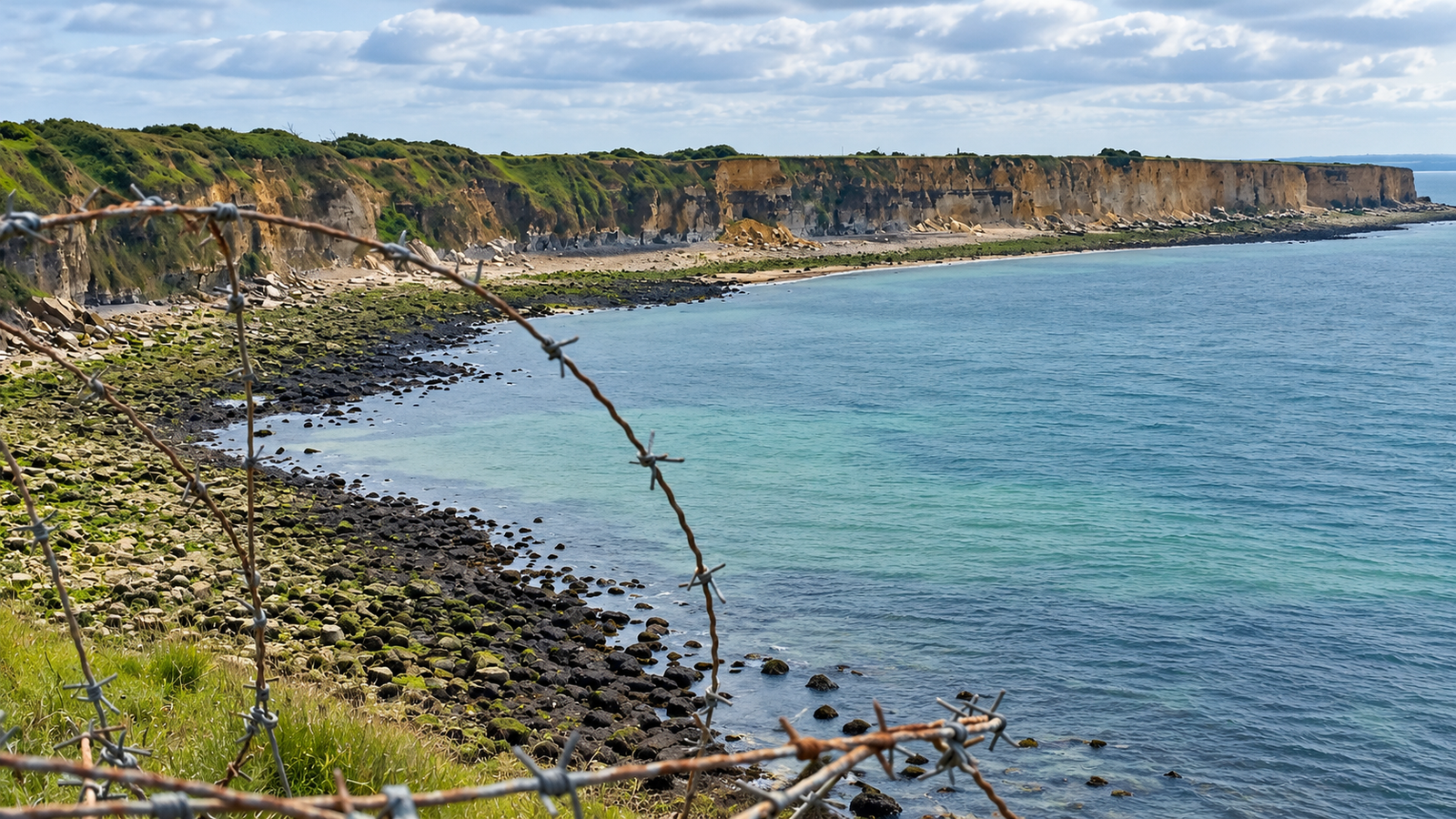
When we visited Normandy with our two teenage sons, we booked a half-day tour from Bayeux. Our family loves history, and with limited time, it was a convenient way to visit Omaha Beach, Pointe du Hoc and the Normandy American Cemetery.
But there were moments when I wanted to linger, and places along the way where I wished we could stop.
If I were planning it again, I would stay in Bayeux for two nights and give the D-Day sites a full day with our own car. A little preparation would let us choose our stops and spend time where it mattered most.
This is the self-guided approach I would use next time, with two route options to help you plan your own day.
Start with two nights in Bayeux
For this itinerary, I would keep the overnight arrangements simple:
- Arrival day: Settle into Bayeux, explore town and have dinner.
- Full day: Drive your chosen D-Day route.
- Departure day: Continue your Normandy trip after breakfast.
We stayed in a centrally located Bayeux hotel with public parking across the street. Being able to walk into the historical center was lovely after a day of sightseeing.
Check parking before booking your accommodation. You want an easy place to leave the car and an evening you can enjoy on foot.
Choose your priorities before choosing your route
My suggestion is to read about the sites below and shortlist up to five stops. Then check how they fit together on a map.
Five is a starting point, not a target you must reach. A beach walk and a two-hour museum visit use very different amounts of time.
The general geographical order is:
Sainte-Mère-Église and nearby Utah Beach → Pointe du Hoc → Omaha Beach → Normandy American Cemetery → Longues-sur-Mer → Juno Beach
Sainte-Mère-Église is inland, so this is an orientation guide rather than a straight coastal drive.
You do not need to cover the whole coastline in one day. Choose the history that interests you most and leave room for lunch, walking and an unexpected stop.
The D-Day sites: what to see and why
The times below are suggested planning allowances, not fixed visit lengths. Add driving, parking and meals separately.
Sainte-Mère-Église and the Airborne Museum
Choose this for: The American airborne landings and the stories behind familiar wartime photographs.
This would be my first priority on a return visit. I have seen so many photographs of Sainte-Mère-Église that I would love to put the buildings and streets into context.
The Airborne Museum focuses on the American paratroopers of the 82nd and 101st Airborne Divisions. Its collection includes a glider and a C-47 aircraft, alongside immersive displays about the landings.
Allow around two hours for the museum, plus time to look around the town and church square. That is also the museum’s own recommended visit length. Airborne Museum visitor information
Utah Beach
Choose this for: An American landing beach that pairs naturally with Sainte-Mère-Église.
Utah Beach helps connect the airborne operations inland with the landings on the coast. Visit the beach and memorials, or make the Utah Beach D-Day Museum your main museum stop.
Allow 45–60 minutes for the beach and memorials. A museum visit needs additional time, so decide whether you want to explore both museums or give one your full attention. Utah Beach D-Day Museum
Pointe du Hoc
Choose this for: Understanding the terrain faced by the American Rangers.
Standing at Pointe du Hoc, I was in awe that anyone survived the climb up those cliffs. Photographs had given me an idea of the place. Seeing it in person was something else entirely.
The Rangers scaled the cliffs on June 6, 1944, to attack a German coastal position. The surviving bunkers and bomb-scarred landscape help explain the difficulty of that mission.
Allow around an hour, depending on walking pace and the areas accessible during your visit.
Check before traveling: Preservation work is scheduled through mid-2027. The site remains open with restrictions affecting parking, paths, bunkers and the visitor center. Follow the current arrangements rather than an older walking map. ABMC restoration updates
Omaha Beach
Choose this for: Time on the shoreline where American troops landed.
What struck me most was the sheer size of Omaha Beach. Standing there and trying to imagine the landings was difficult to take in.
This is one place where I would have liked more time on our tour. On a self-guided day, you can walk, read the memorials and pause without watching for the group to leave.
For a straightforward stop, map Les Braves monument at Saint-Laurent-sur-Mer, then check nearby public parking.
Allow 45–60 minutes, or longer if you want a substantial walk. Omaha is a stretch of coastline, so save a specific arrival point rather than simply searching for “Omaha Beach.”
Normandy American Cemetery, Colleville-sur-Mer
Choose this for: Remembrance and reflection above Omaha Beach.
The rows of headstones stayed with me. Then we heard Taps as the flag was lowered. That moment made a lasting impression on all of us.
The cemetery overlooks Omaha Beach and includes a visitor center, memorial, chapel and Garden of the Missing.
Allow around 90 minutes. Give yourself space to absorb the experience rather than treating it as a quick final stop.
Want to attend the flag lowering? ABMC states that it takes place one hour before the cemetery closes. Confirm the closing time and ceremony arrangements for your date before setting your route. Official cemetery information
Also check booking requirements: ABMC has announced anticipated preregistration for visits beginning in summer 2027. Admission will remain free. Visitor registration updates
Longues-sur-Mer Gun Battery
Choose this for: Seeing German coastal defenses and their original artillery.
Between the Omaha and Gold sectors, Longues-sur-Mer offers a different perspective on the landings. Its concrete gun positions still contain their original guns, making the defensive system easier to understand.
Allow 45–60 minutes to walk around and read the interpretation panels. The local tourist office lists a one-kilometer interpretation circuit. Longues-sur-Mer interpretation trail
Juno Beach and the Juno Beach Centre
Choose this for: The Canadian contribution to D-Day and the wider war.
At Courseulles-sur-Mer, the Juno Beach Centre tells the story of Canada’s military and civilian wartime effort. Pair the museum with time outside on the beach.
Allow around two hours for the museum and a short beach visit. If you add a scheduled bunker tour, allow extra time and check its availability separately. Juno Beach Centre visitor details
Route option 1: The western D-Day loop
Best for: Readers prioritizing the American airborne story and landing sites.
Bayeux → Sainte-Mère-Église → Utah Beach → Pointe du Hoc → Omaha Beach → American Cemetery → Bayeux
This is the five-stop day I would consider for my return visit.
- Morning: Sainte-Mère-Église and the Airborne Museum.
- Late morning: Utah Beach, focusing on the beach and memorials.
- Lunch: Choose a stop along your onward route.
- Afternoon: Pointe du Hoc, Omaha Beach and the American Cemetery.
This is a full day. With the Airborne Museum included, I would save the Utah Beach museum for another visit.
If the cemetery ceremony is important, work backward from its confirmed time. Start early and shorten or remove a stop if needed. You can also visit Omaha afterward using a separate public beach access; the cemetery’s direct beach path is closed. ABMC access information
Route option 2: A coastal day with Canadian and American history
Best for: Readers who want Juno Beach alongside Omaha and the cemetery.
Bayeux → Juno Beach → Longues-sur-Mer → Pointe du Hoc → Omaha Beach → American Cemetery → Bayeux
Starting at Juno lets you visit its museum in the morning. Continue west through Longues-sur-Mer, then return east from Pointe du Hoc through Omaha to the cemetery.
There is some deliberate backtracking here to place the cemetery later in the day. If the ceremony does not matter to you, reorder those last three stops to suit opening hours and your preferred pace.
For a stronger British focus, consider replacing Pointe du Hoc with Arromanches and the Gold Beach story, including the remains of the artificial harbor. Make it a swap so the day stays manageable. Gold Beach and Arromanches
A little preparation makes the day easier
- Read a short history of each chosen stop. A map and some background help connect quiet landscapes with what happened there.
- Save exact parking and entrance locations. Check the full driving route before leaving Bayeux.
- Check opening hours and last admission. Museums and memorial sites have different arrangements.
- Bring a windproof layer. I remember the wind, even during our June visit.
- Wear comfortable shoes with grip. Expect a mixture of sand, paths, grass and uneven ground.
- Plan lunch and bathroom breaks. Check facilities at your chosen stops rather than assuming every outdoor site has them.
- Leave some flexibility. The freedom to linger is one of the main reasons I would choose a self-guided visit.
Would I choose a tour again?
Our half-day tour made sense for the time we had. It brought us to three extraordinary places, and I am glad we went.
But next time, I would give this part of Normandy a full day, choose the sites that interest us most and drive ourselves. I would like more time at Omaha, the chance to explore Sainte-Mère-Église and the freedom to stop when something catches our attention.
Choose your priorities, put them in a sensible order and give yourself time to be there.
For help fitting this day into a longer visit, see my Plan Your Normandy Trip guide.
Keep your planning moving.
Plan Your Normandy TripThis is general planning information. Routes, fares and policies can change; check official sources for your travel dates.